
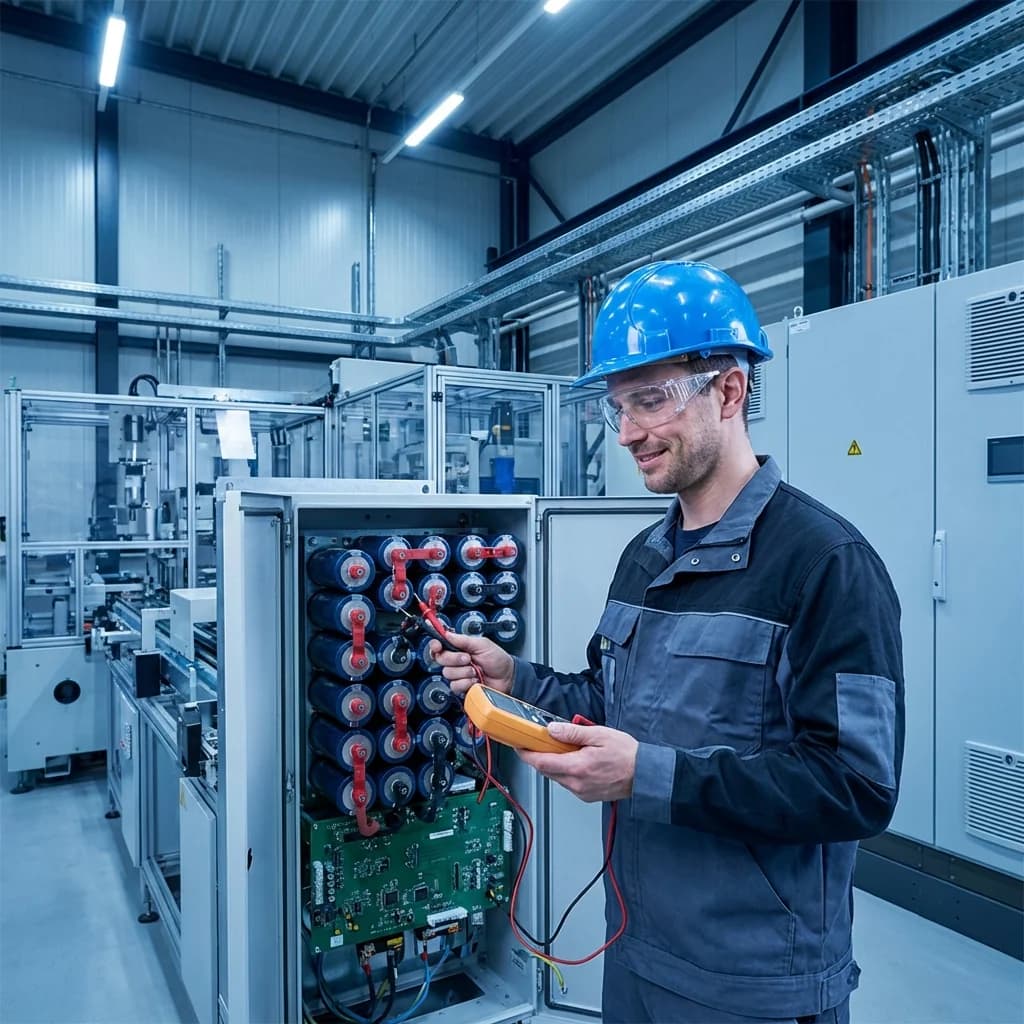
Battery Management System (BMS) Capacitors
Overview
Technical Advantages
Low-leakage, tight-tolerance capacitors for accurate cell voltage monitoring
AEC-Q200 qualified options for automotive EV battery pack compliance
Wide temperature range components for outdoor and under-hood environments
Technical expertise in BMS capacitor selection and cross-referencing
Inventory depth across ceramic, film, polymer, and tantalum technologies
Battery Management System (BMS) Capacitor Applications
Battery management systems are the intelligence behind every modern battery pack — from electric vehicle traction batteries to grid-scale energy storage systems to portable medical devices. A BMS monitors cell voltages, manages charging and discharging, implements safety protections, and performs cell balancing to maximize battery life and performance. Each of these functions depends on carefully selected capacitors, where the wrong choice can mean inaccurate measurements, safety hazards, or premature battery degradation. At Specap, we supply the precision capacitors that BMS designers and manufacturers need — from low-leakage C0G MLCC for cell monitoring to AEC-Q200 qualified components for automotive EV battery packs. #
Cell Balancing Capacitor Requirements
Cell balancing is one of the most capacitor-critical functions in a BMS. In a series-connected battery pack, individual cells inevitably develop charge imbalances over time due to manufacturing variations, temperature gradients, and aging differences. The BMS must equalize cell voltages to prevent overcharging of any single cell and to maximize usable pack capacity. - **Passive Balancing Capacitors**: In passive (dissipative) balancing circuits, capacitors filter the switched balancing current and bypass high-frequency noise from the balancing FETs. Low-ESR ceramic capacitors (MLCC) from Murata (GRM series) and TDK (C series) in C0G or X7R dielectric are standard choices. Capacitors must have low leakage current to avoid introducing measurement errors in the cell monitoring circuitry. - **Active Balancing Capacitors**: Active (redistributive) balancing topologies use capacitors as energy transfer elements — switched-capacitor balancers shuttle charge between cells using flying capacitors. These capacitors must have tight tolerance (±5% or better), low ESR, and extremely low leakage current. Film capacitors in polypropylene or polyester dielectric are often preferred for this role due to their inherently low leakage and excellent stability over temperature and aging. - **Capacitor Matching**: For multi-cell BMS designs, matched capacitor sets ensure consistent balancing performance across all cells. Specap can supply matched-tolerance capacitor kits for production BMS builds. #
BMS Protection Circuit Capacitors
The BMS protection circuitry monitors cell voltages, pack current, and temperature to prevent dangerous operating conditions: - **Current Sensing Filter Capacitors**: High-side and low-side current sense amplifiers use RC filter networks to reject switching noise while accurately measuring pack current. The capacitor in this filter must have stable capacitance over temperature and voltage — C0G/NP0 MLCC from Murata or TDK provide near-zero temperature coefficient and no DC bias derating, making them the ideal choice. Common values are 100pF to 10nF. - **Voltage Monitoring Capacitors**: Each cell voltage channel on BMS ICs (such as Texas Instruments BQ769x0, Analog Devices LTC6810/6811, or NXP MC33771) includes filter capacitors that reject noise and protect the IC inputs. These capacitors must have very low leakage current — typically below 1µA — to avoid corrupting the microvolt-level voltage measurements. C0G MLCC with rated voltage well above the cell voltage (e.g., 50V rated for a 4.2V cell) minimizes leakage. - **Bypass and Decoupling Capacitors**: BMS ICs require low-ESR bypass capacitors on their power supply pins and reference voltage pins. A combination of 100nF X7R MLCC (for broadband decoupling) and 10µF polymer or tantalum capacitors (for bulk energy storage) is typical. KEMET T491 automotive-grade tantalum and Panasonic POSCAP polymer series provide the low ESR and stable capacitance needed. #
Pre-Charge Circuits for High-Voltage Battery Packs
When a high-voltage battery pack (typically 300V-800V in EVs) connects to the inverter or DC-DC converter, the large uncharged DC link capacitors on the load side appear as a near-short-circuit. Without pre-charge, the resulting inrush current can weld contactor contacts, damage capacitors, and trip protection circuits. - **Pre-Charge Resistor/Capacitor Design**: The pre-charge circuit uses a resistor (and sometimes a capacitor) to gradually charge the load-side capacitors before closing the main contactor. The pre-charge timing capacitor must withstand the full pack voltage and operate reliably over the vehicle's lifetime. Film capacitors in polypropylene dielectric — such as KEMET C4AQ series or Vishay MKP385 series — rated for 500V-1000V DC are the standard choice. - **Pre-Charge Monitoring**: A voltage divider with filter capacitors monitors the load-side voltage rise during pre-charge, signaling the BMS when it is safe to close the main contactor. These monitoring capacitors must have tight tolerance and low leakage for accurate voltage measurement. #
Thermal Management and Wide Temperature Range
BMS components operate across extreme temperature ranges, particularly in automotive and outdoor energy storage applications: - **Automotive Temperature Range**: AEC-Q200 qualification requires operation from -40°C to +125°C (or +150°C for under-hood placement). At temperature extremes, capacitor parameters change significantly — X7R MLCC can lose 15-20% of capacitance at -40°C and at maximum rated temperature. Designers must account for these shifts in their BMS circuit analysis. C0G dielectric provides the most stable performance across temperature but is limited to lower capacitance values. - **Thermal Cycling Reliability**: Battery packs experience daily temperature cycles that stress solder joints and component terminations. MLCC capacitors in larger case sizes (0805 and above) with flexible terminations — such as Murata NFM series soft-termination MLCC — resist cracking caused by PCB flexure and thermal cycling. This is especially important for large-format prismatic and pouch cell BMS boards that experience mechanical stress during cell swelling. - **Cold Weather Performance**: At -20°C to -40°C, standard aluminum electrolytic capacitors suffer dramatically increased ESR and reduced capacitance. Polymer aluminum capacitors maintain lower ESR at cold temperatures, making them a better choice for BMS power supply sections in cold-climate applications. Panasonic SP-Cap and Nichicon PCJ series maintain ESR below 30mΩ even at -40°C. #
EMI Filtering in Battery Systems
Battery packs and their associated power electronics generate significant electromagnetic interference that can corrupt BMS measurements: - **Differential Mode Filtering**: Ceramic MLCC and film capacitors filter high-frequency differential noise on cell monitoring lines. Multi-layer ceramic capacitors in C0G dielectric provide consistent filtering performance. TDK CGA series and Murata GCM series offer AEC-Q200 qualified options for automotive BMS. - **Common Mode Filtering**: Common mode chokes paired with Y-rated safety capacitors suppress common mode noise between the high-voltage battery domain and the low-voltage BMS domain. This isolation boundary is critical for safety and measurement accuracy. - **Switching Noise Rejection**: BMS boards located near the battery pack's power contactors, pre-charge circuits, and cell balancing FETs must filter switching transients. LC filter networks using MLCC and ferrite beads at the input to sensitive analog circuits prevent noise from reaching the ADC inputs of BMS monitoring ICs. #
Automotive BMS Requirements (AEC-Q200)
For automotive EV applications, BMS capacitors must meet the AEC-Q200 stress test qualification: - **Temperature Cycling**: 1,000 cycles from -55°C to +125°C (or +150°C) without parametric drift exceeding specified limits. - **Humidity Resistance**: 1,000 hours at 85°C/85% relative humidity with voltage applied (THB testing). - **Vibration**: Compliance with ISO 16750 vibration profiles appropriate for the mounting location. - **Life Testing**: 1,000-2,000 hours at maximum rated temperature and voltage. Specap stocks AEC-Q200 qualified capacitors from Murata, TDK, KEMET, Panasonic, and Vishay for automotive BMS applications. Our team can help identify the AEC-Q200 equivalent of commercial-grade capacitors already in your prototype design. #
Why Choose Specap for BMS Capacitors?
Battery management systems demand capacitors with specific and exacting requirements — low leakage, tight tolerance, stable performance across temperature, and proven automotive-grade reliability. With over 40 years of experience in specialty capacitor distribution, Specap maintains deep inventory across all the capacitor technologies used in BMS designs. Our technical team understands BMS circuit requirements and can recommend optimal capacitor selections, provide cross-references between manufacturers, and source hard-to-find automotive-qualified components. For production BMS builds, we offer matched-tolerance capacitor kits and volume pricing through our [quote system](/quote).
Case Studies & Success Stories
EV Battery Pack BMS Capacitor Qualification
The Challenge
X7R MLCC capacitors in the BMS cell monitoring circuits were exhibiting excessive capacitance drift at temperature extremes, causing intermittent cell voltage measurement errors that triggered false overvoltage warnings in a 96-cell battery pack.
The Solution
Specap supplied Murata GCM series AEC-Q200 qualified C0G MLCC capacitors with ±1% tolerance for all cell monitoring filter positions, along with KEMET T491 automotive-grade tantalum capacitors for BMS IC power supply decoupling.
The Result
Eliminated all false voltage measurement errors across the -40°C to +85°C operating range. The BMS passed full AEC-Q200 qualification on the first submission, enabling on-time SOP for the customer's next-generation EV platform.
Industrial Energy Storage System BMS Upgrade
The Challenge
A 2MWh containerized lithium-ion battery storage system in a desert climate experienced BMS measurement drift during summer months when container temperatures reached 55°C, reducing the usable capacity window and degrading round-trip efficiency.
The Solution
Replaced commercial-grade X7R MLCC with extended-temperature C0G/NP0 capacitors from TDK (CGA series) for critical measurement circuits and upgraded power supply decoupling to Panasonic SP-Cap polymer capacitors with superior high-temperature ESR performance.
The Result
BMS measurement accuracy improved by 40% at elevated temperatures, enabling the operator to safely utilize 95% of pack capacity versus the previous 85%, increasing annual revenue by $180,000 per installation.
Capacitor Types Explained
Compare ceramic, film, polymer, and tantalum capacitors for BMS design
Read guideFilm Capacitor Selection Guide
Polypropylene and polyester film capacitors for pre-charge and EMI filtering
Read guideEMI/EMC Filter Capacitor Guide
X and Y safety capacitors for battery system EMI compliance
Read guide