Capacitor Shelf Life: How Long Can You Store Capacitors?
Last Updated: February 2026 | Reading Time: 9 minutes
Whether you are managing a warehouse of spare parts, buying surplus inventory, or wondering if that box of capacitors from five years ago is still usable, shelf life is a practical concern. Not all capacitors age the same way in storage. Some types can sit for decades without any measurable degradation, while others --- particularly aluminum electrolytics --- begin deteriorating within a couple of years of leaving the factory. Understanding the differences lets you make informed purchasing, storage, and testing decisions that protect both your equipment and your budget.
This guide covers shelf life expectations by capacitor type, the science behind storage degradation, proper storage conditions, and how to evaluate whether stored capacitors are still fit for service.
Shelf life is primarily a concern for aluminum electrolytic capacitors, and the reason comes down to chemistry. Aluminum electrolytics use an extremely thin aluminum oxide (Al2O3) dielectric layer formed on etched aluminum foil. This oxide layer is not permanent --- it requires periodic voltage application to remain intact. Without applied voltage, the oxide gradually dissolves back into the electrolyte, thinning the dielectric and increasing leakage current.
For procurement and maintenance teams, the practical implications are significant:
- Spare parts inventories for industrial equipment, UPS systems, and HVAC systems often sit for years before use
- NOS (New Old Stock) capacitors purchased as obsolete replacements may have date codes a decade or more old
- Bulk purchases made to lock in pricing or secure supply during shortages may exceed shelf life before deployment
Installing a degraded electrolytic capacitor without proper evaluation can result in excessive leakage current, overheating, venting, or outright failure at power-on.
Not every capacitor technology degrades during unpowered storage. The following table summarizes realistic shelf life expectations under standard warehouse conditions (15-35°C, moderate humidity):
| Capacitor Type | Typical Shelf Life | Primary Concern | Action Required After Shelf Life |
|---|
| Aluminum Electrolytic | 2-3 years | Oxide layer dissolution, electrolyte evaporation | Test and reform before use |
| Tantalum Electrolytic | 5+ years | Gradual oxide degradation (slower than aluminum) | Test leakage current before use |
| Film (Polypropylene, Polyester, PET) | 10+ years | Essentially unlimited under proper conditions | Visual inspection, basic testing |
| Ceramic (MLCC) | Indefinite | No storage aging mechanism | Verify solderability if very old |
| Mica | Indefinite | No storage aging mechanism | Verify solderability if very old |
The key takeaway: if the capacitor in question is a film, ceramic, or mica type, shelf life is effectively a non-issue. If it is an aluminum electrolytic, shelf life is a real operational concern that requires attention.
Understanding the degradation mechanism helps explain why aluminum electrolytics have such limited shelf life compared to other types.
The aluminum oxide dielectric is formed through anodization --- an electrochemical process where applied voltage drives a reaction between the aluminum foil and the electrolyte, growing the oxide film. When voltage is removed, the reverse process begins. The electrolyte slowly dissolves the oxide layer, thinning the dielectric barrier.
The rate of dissolution depends on temperature and electrolyte chemistry, but it is always occurring in unpowered storage. After 2-3 years, the oxide layer may have thinned enough to significantly increase leakage current when voltage is reapplied.
A thinner oxide layer means less insulation between the anode and cathode. When you apply rated voltage to a capacitor with a degraded oxide, the initial leakage current can be orders of magnitude higher than the manufacturer's specification. This excess current generates heat, which can cause thermal runaway in severe cases.
Even in storage, the liquid or gel electrolyte slowly diffuses through the rubber end seal. This is a much slower process than oxide dissolution and is more relevant over very long storage periods (10+ years), but it contributes to increased ESR and reduced capacitance over time. High storage temperatures dramatically accelerate electrolyte loss.
Correct storage extends the useful shelf life of all capacitor types and slows degradation in electrolytics.
Store capacitors between 5°C and 35°C (40-95°F). Avoid locations subject to temperature extremes, such as unconditioned warehouses, attics, or shipping containers. For aluminum electrolytics, every 10°C increase in storage temperature roughly doubles the rate of oxide degradation and electrolyte evaporation.
Maintain relative humidity between 40% and 70%. Excessive humidity promotes corrosion on leads and terminals, degrades packaging, and can cause moisture absorption in some capacitor types. Very low humidity increases the risk of electrostatic discharge. Sealed moisture-barrier bags with desiccant packs are ideal for long-term storage.
Capacitors with voltage ratings above a few volts can develop and hold significant static charges. Store them in ESD-safe packaging, especially surface-mount types. Tantalum and ceramic SMD capacitors are particularly susceptible to ESD damage.
- Keep original packaging --- manufacturer packaging is designed for storage protection
- Use FIFO inventory management (first in, first out) to minimize storage duration
- Label date received on all incoming stock, not just the date code
- Store away from direct sunlight, chemicals, and solvents
- Avoid vibration --- repeated mechanical stress can damage internal connections in larger capacitors
Before installing any capacitor that has been stored beyond its expected shelf life, basic testing can prevent failures.
Check for:
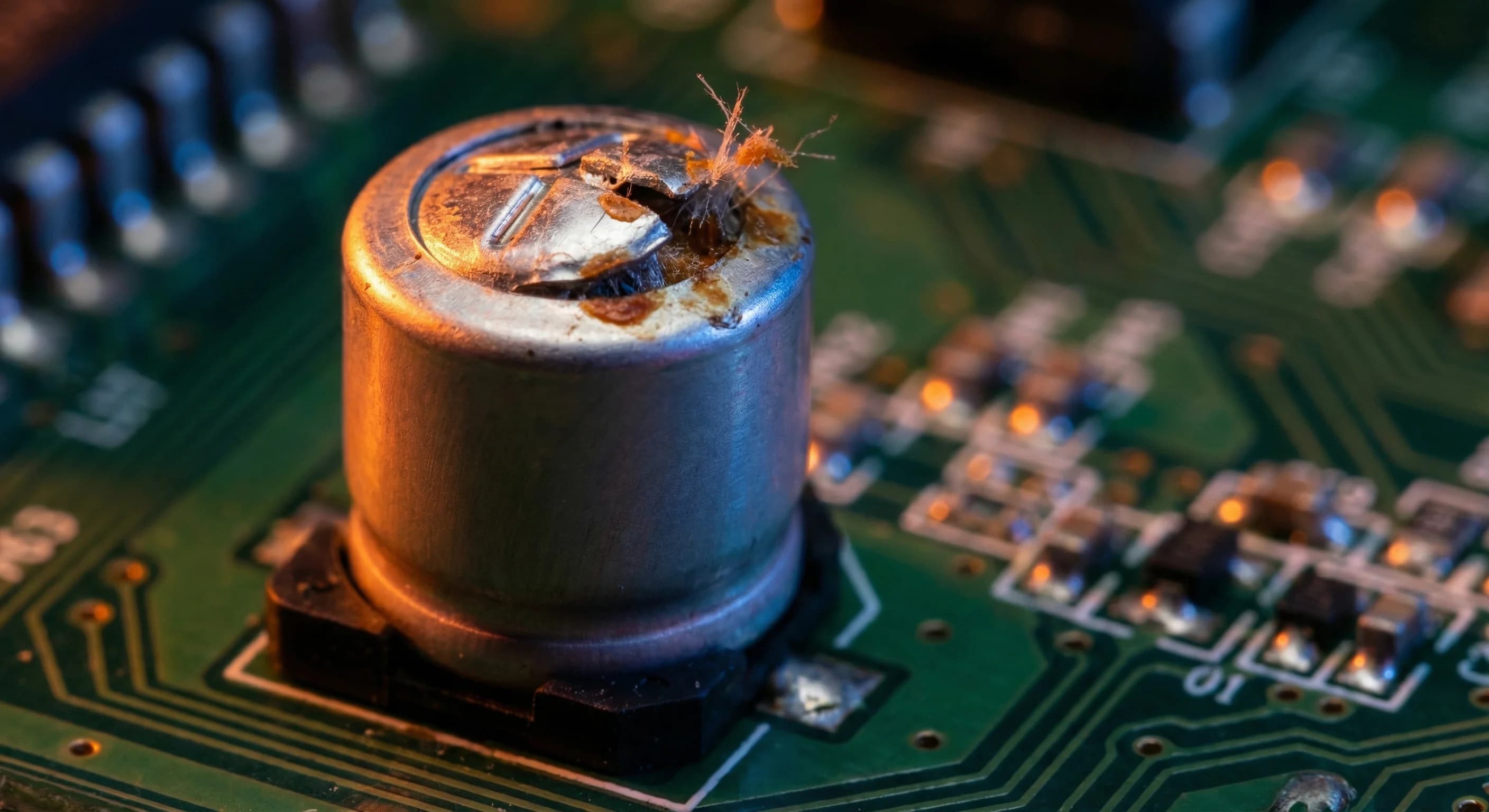
- Bulging or swelling of the capacitor case (electrolytics)
- Electrolyte leakage (dark stains, crystalline residue around the base seal)
- Corroded or oxidized leads
- Damaged or cracked packaging
Any of these signs indicate the capacitor should be discarded.
At minimum, measure the following:
- Capacitance --- should be within the manufacturer's tolerance (typically +/-20% for electrolytics). A reading more than 20% below nominal suggests significant degradation.
- ESR (Equivalent Series Resistance) --- compare to the datasheet value. Elevated ESR indicates electrolyte loss or internal degradation. An ESR meter or LCR bridge is essential for this measurement.
- Leakage current --- apply rated voltage through a current-limiting resistor and monitor leakage current over several minutes. Leakage should decrease and stabilize below the datasheet maximum. If leakage remains high or increases, the capacitor needs reforming or replacement.
For detailed testing procedures, see our How to Test a Capacitor with a Multimeter guide and our Advanced Capacitor Testing guide.
If an aluminum electrolytic capacitor has exceeded its shelf life but passes visual inspection, it may be recoverable through reforming. Reforming is the process of gradually reapplying voltage to rebuild the oxide dielectric layer.
The basic principle: apply voltage starting well below the rated value and slowly increase it over several hours while monitoring leakage current. The applied voltage drives the anodization reaction, re-growing the oxide layer. As the oxide rebuilds, leakage current decreases.
Reforming is appropriate when:
- The capacitor has been stored unpowered for more than 2-3 years
- Visual inspection shows no physical damage
- You need the specific part and a fresh replacement is unavailable
Reforming is NOT appropriate when:
- The capacitor shows physical damage (bulging, leaking, corroded leads)
- Electrolyte has visibly dried out
- The capacitor has been stored in extreme conditions for a very long period
We have a comprehensive step-by-step procedure in our Capacitor Reforming Guide, including recommended voltage ramp rates, current limits, and safety precautions.
NOS capacitors --- unused parts from discontinued production runs --- are often the only option for repairing legacy equipment where exact replacements are required. However, NOS electrolytic capacitors require careful evaluation.
Date codes matter. A four-digit date code like "1815" means the 15th week of 2018. That capacitor has been sitting unpowered for nearly eight years. The oxide layer has almost certainly degraded significantly.
Storage history is usually unknown. You rarely know whether an NOS capacitor was stored in a climate-controlled warehouse or a hot shipping container. Assume worst-case conditions and test accordingly.
Reforming is almost always necessary for NOS aluminum electrolytics with date codes more than 2-3 years old. Factor the time and effort of reforming into your project timeline.
Film, ceramic, and mica NOS parts are generally safe to use regardless of age, provided they pass visual inspection and basic electrical testing. The main concern with very old stock of these types is lead solderability --- oxidized leads may require cleaning or re-tinning before soldering.
When sourcing NOS capacitors, work with a supplier that understands these considerations and can provide proper storage history and testing. At Specap, we test and, where necessary, reform NOS electrolytic capacitors before shipping to ensure they are ready for service.
Aluminum electrolytic capacitors effectively do expire in storage, with a practical shelf life of 2-3 years under standard conditions. The oxide dielectric layer degrades without applied voltage, increasing leakage current and reducing reliability. Film, ceramic, and mica capacitors do not have a meaningful storage expiration and can last indefinitely if stored properly.
Possibly, but not without evaluation. A 10-year-old aluminum electrolytic must be visually inspected, electrically tested, and almost certainly reformed before use. If the capacitor passes reforming --- leakage current drops to within specification and capacitance is within tolerance --- it can be used. If it does not respond to reforming, it should be replaced. See our Capacitor Reforming Guide for the full procedure.
Store in a temperature-controlled environment between 5-35°C with 40-70% relative humidity. Keep capacitors in their original packaging, use moisture-barrier bags with desiccant for bulk storage, and maintain ESD-safe handling procedures. Use FIFO inventory rotation and clearly label the date received on all stock.
Yes, these are distinct concepts. Shelf life refers to how long a capacitor can be stored unpowered before it degrades. Operational life refers to how long a capacitor functions under power and load before its parameters drift out of specification. An aluminum electrolytic might have a 2-3 year shelf life but a 5,000-10,000 hour operational life at rated temperature. For a deeper discussion of operational aging, see our Capacitor Aging and End-of-Life Management guide.
Yes. Tantalum electrolytic capacitors use tantalum pentoxide (Ta2O5) as the dielectric, which is more chemically stable than aluminum oxide. Tantalum capacitors have a shelf life of 5 or more years and degrade much more slowly in storage. However, they are more expensive, available in a narrower range of capacitance and voltage values, and are sensitive to voltage transients. They are a good choice when long storage is expected, but they do not replace aluminum electrolytics in all applications.