Do Electrolytic Capacitors Degrade in Speaker Crossovers?
Last Updated: February 2026 | Reading Time: 10 minutes
The short answer is yes. Electrolytic capacitors in speaker crossovers degrade over time, and after 10 to 20 years of use, they are almost certainly out of specification. This degradation is not a design flaw or a manufacturing defect --- it is an inherent limitation of the electrolytic capacitor's construction. The liquid electrolyte that makes these capacitors work slowly evaporates through the seal, changing the capacitor's electrical properties and shifting the crossover frequencies in your speakers. If your speakers are more than 15 years old and still have their original electrolytic crossover capacitors, their sound today is not what the designer intended.
This guide explains how crossover capacitors work, why electrolytics degrade in audio applications, how that degradation affects your sound, and what replacement options will restore --- or even improve --- your speakers' performance.
A speaker crossover is a passive filter network that divides the full-range audio signal into frequency bands and routes each band to the appropriate driver. The tweeter receives high frequencies, the woofer receives low frequencies, and in three-way systems, the midrange driver handles everything in between.
Capacitors are the core component of these filter networks:
- High-pass filters use a capacitor in series with the tweeter. The capacitor blocks low frequencies and passes high frequencies above the crossover point.
- Low-pass filters use an inductor in series with the woofer, often with a capacitor to ground to sharpen the rolloff.
- Band-pass filters combine both high-pass and low-pass sections to create a frequency window for midrange drivers.
The capacitor value directly determines the crossover frequency. A 10uF capacitor paired with an 8-ohm tweeter creates a crossover point at approximately 2,000 Hz. Change that capacitance value --- whether intentionally or through degradation --- and the crossover frequency shifts, altering the speaker's tonal balance and imaging.
Speaker manufacturers historically used electrolytic capacitors in crossovers because they offered the required capacitance values (typically 1uF to 100uF) at low cost and in compact packages. However, electrolytic capacitors have a fundamental weakness: their liquid electrolyte slowly evaporates through the rubber end seal over time.
Three key parameters change as this happens:
ESR Increases. Equivalent Series Resistance (ESR) is the internal resistance of the capacitor. As the electrolyte dries out, the effective contact area between the electrolyte and the aluminum oxide dielectric shrinks. ESR can increase from a fraction of an ohm to several ohms. In a crossover circuit, this added resistance acts like a resistor in series with the signal path, attenuating the signal and introducing frequency-dependent losses.
Capacitance Drifts. As electrolyte volume decreases, the effective plate area decreases with it. A capacitor originally rated at 10uF may measure 7uF or 8uF after 15 to 20 years. In some cases, the drift can exceed 30 percent of the original value.
Dielectric Absorption Worsens. Aging electrolytic capacitors exhibit increased dielectric absorption --- the tendency to retain a residual charge after discharge. In audio circuits, this manifests as a subtle smearing of transient detail, reducing the clarity of percussive instruments and vocal consonants.
These degradation mechanisms accelerate with temperature. Crossovers mounted inside sealed speaker cabinets, particularly those driven at high volumes, experience elevated temperatures that shorten electrolytic life significantly.
The changes caused by capacitor degradation are gradual, which makes them difficult to notice day to day. Over years, listeners unconsciously adjust to the degraded sound. But the cumulative effects are substantial:
- Shifted crossover frequency. A high-pass capacitor that has lost 20 percent of its capacitance shifts the crossover point upward. This means the tweeter handles a narrower frequency range, creating a gap in the upper-midrange where neither the tweeter nor the woofer reproduces the signal effectively.
- Reduced high-frequency response. Rising ESR in the tweeter's high-pass capacitor attenuates the signal reaching the tweeter. High frequencies lose their sparkle and air, and the overall sound becomes dull and lifeless.
- Muddy or congested midrange. When crossover points shift and filter slopes soften, drivers overlap in frequency ranges where they were never designed to operate together. This overlap creates phase cancellations and comb filtering, producing a muddy, congested sound.
- Reduced imaging and soundstage. Precise stereo imaging depends on matched crossover characteristics between left and right speakers. Capacitors in each speaker age at different rates, introducing channel-to-channel imbalances that collapse the soundstage.
- Loss of transient detail. Increased dielectric absorption and ESR slow the capacitor's response to fast-changing signals, softening the leading edge of transients.
Watch for these symptoms, especially in speakers older than 15 years:
- Dull or veiled treble that cannot be corrected with equalization or positioning
- Harsh or fatiguing sound in the crossover region, caused by driver overlap from shifted frequencies
- Noticeable difference between left and right speakers in tonal balance or imaging
- Audible distortion at moderate volumes that was not present when the speakers were new
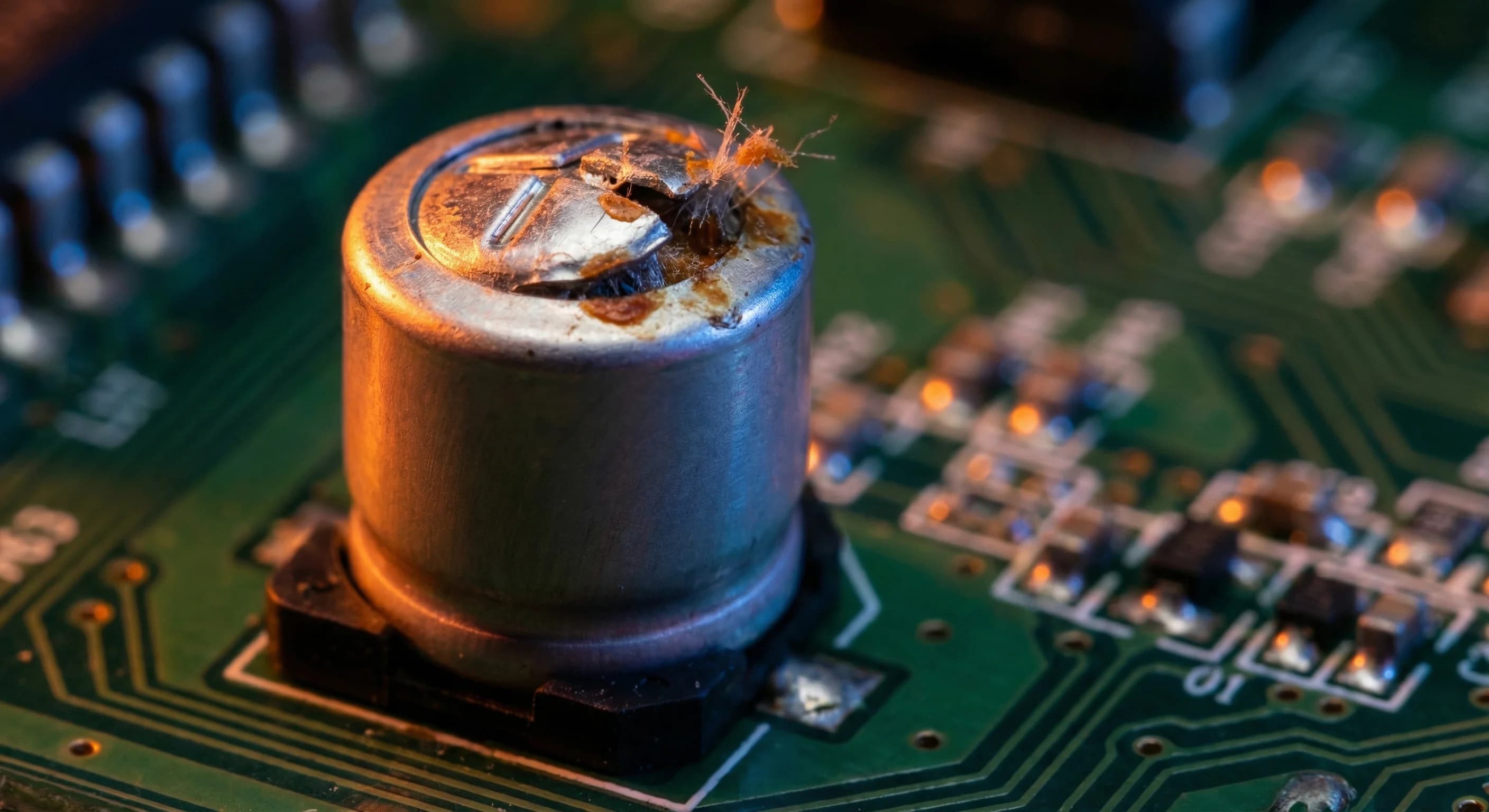
- Visible electrolyte leakage (brown or dark residue) around the capacitor leads or body
- Bulging or swollen capacitor bodies, indicating internal pressure from electrolyte breakdown
If your speakers exhibit any of these symptoms and still have their original electrolytic crossover capacitors, capacitor replacement should be the first step before considering any other upgrades.
Before replacing capacitors, you can measure them to confirm degradation. You will need to desolder at least one lead of each capacitor from the crossover board for accurate measurement.
Capacitance measurement: Use a digital multimeter with a capacitance function or a dedicated LCR meter. Compare the measured value to the value printed on the capacitor body. A deviation greater than 10 percent from the original value indicates significant degradation.
ESR measurement: A standard multimeter cannot measure ESR. You need a dedicated ESR meter or an LCR meter capable of measuring at 1 kHz or higher. For crossover capacitors in the 1uF to 100uF range, a healthy electrolytic should measure below 1 ohm ESR. Values above 2 to 3 ohms indicate substantial degradation.
Practical tip: If you are testing capacitors in a speaker that is more than 20 years old, replacement is almost always justified even if the measurements appear borderline. The degradation will only continue, and the cost of quality film capacitors is modest relative to the value of the speakers.
When replacing crossover capacitors, you have two choices: replace with new electrolytics of the same value or upgrade to film capacitors.
Replacing with new electrolytics is the budget option. It restores the original crossover performance, but the new electrolytics will begin degrading from day one, and you will face the same problem again in 10 to 20 years.
Upgrading to film capacitors is the recommended approach. Film capacitors use a thin plastic dielectric instead of a liquid electrolyte, which eliminates the primary degradation mechanism entirely. They also offer lower ESR, lower dielectric absorption, and tighter tolerances than electrolytics, meaning your crossovers will perform better than original and maintain that performance for decades.
Polypropylene (PP) film is the gold standard for speaker crossover applications. Polypropylene offers the lowest dielectric absorption, the lowest ESR, and the most neutral sonic character of any film dielectric. It is the material used in virtually all high-end aftermarket crossover capacitors. If your budget allows, polypropylene is always the right choice.
Polyester (PET) film is the budget alternative. Polyester capacitors offer a significant improvement over electrolytics in terms of ESR and lifespan, but they have higher dielectric absorption than polypropylene. For entry-level or mid-range speakers where the cost of polypropylene capacitors would approach or exceed the value of the speakers themselves, polyester film is a sensible compromise.
| Parameter | Original Electrolytic | Aged Electrolytic (15+ Years) | Polypropylene Film | Polyester Film |
|---|
| Capacitance tolerance | +/- 20% | May exceed +/- 30% | +/- 5% to 10% | +/- 5% to 10% |
| ESR (typical, 10uF) | 0.5 to 2 ohms | 2 to 10+ ohms | 0.01 to 0.05 ohms | 0.05 to 0.2 ohms |
| Dielectric absorption | 10 to 15% | Worse with age | 0.01 to 0.05% | 0.2 to 0.5% |
| Expected lifespan | 10 to 20 years | End of life | 30+ years | 25+ years |
| Polarity | Polarized | Polarized | Non-polarized | Non-polarized |
| Physical size (10uF) | Small | Small | Larger | Moderate |
| Relative cost | Low | N/A | High | Moderate |
The size increase with film capacitors is the main practical consideration. A 10uF polypropylene capacitor is physically larger than a 10uF electrolytic. Before ordering, measure the available space inside your speaker cabinet and on the crossover board to confirm that film replacements will fit.
Under typical home listening conditions, electrolytic crossover capacitors last 10 to 20 years before parametric drift becomes audibly significant. Factors that shorten this life include high ambient temperatures, high playback volumes (which generate heat in the crossover), and speakers placed in direct sunlight or near heat sources. Speakers stored in non-climate-controlled environments such as garages or attics degrade faster due to temperature extremes.
Yes, crossover capacitor replacement is a straightforward soldering job. You need a soldering iron, solder, desoldering braid or a solder sucker, and the replacement capacitors. Photograph the original crossover before removing any components so you have a reference for component placement and polarity. If you are upgrading from electrolytic to film, polarity no longer matters since film capacitors are non-polarized, but you must match the original capacitance value and meet or exceed the original voltage rating.
Upgrading to film capacitors restores the crossover to its designed frequency response, and in most cases improves upon it due to tighter tolerances and lower ESR. The result is typically described as clearer highs, tighter midrange, and better transient response. The tonal balance will shift if your ears have adapted to the degraded sound of the old electrolytics, but the new sound is closer to what the speaker designer intended.
Yes. If one electrolytic capacitor has degraded, the others in the same crossover network have aged similarly. Replacing only one creates a mismatch in the filter network. Additionally, always replace capacitors in both speakers at the same time to maintain channel-to-channel matching, which is critical for accurate stereo imaging.
Always match the original capacitance value printed on the capacitor or specified in the speaker's service documentation. Do not change the value in an attempt to "tune" the crossover unless you have the measurement equipment and expertise to redesign the network. The voltage rating of the replacement should be equal to or greater than the original --- for crossover applications, 50V or 100V film capacitors are standard and provide ample margin for any home audio system.